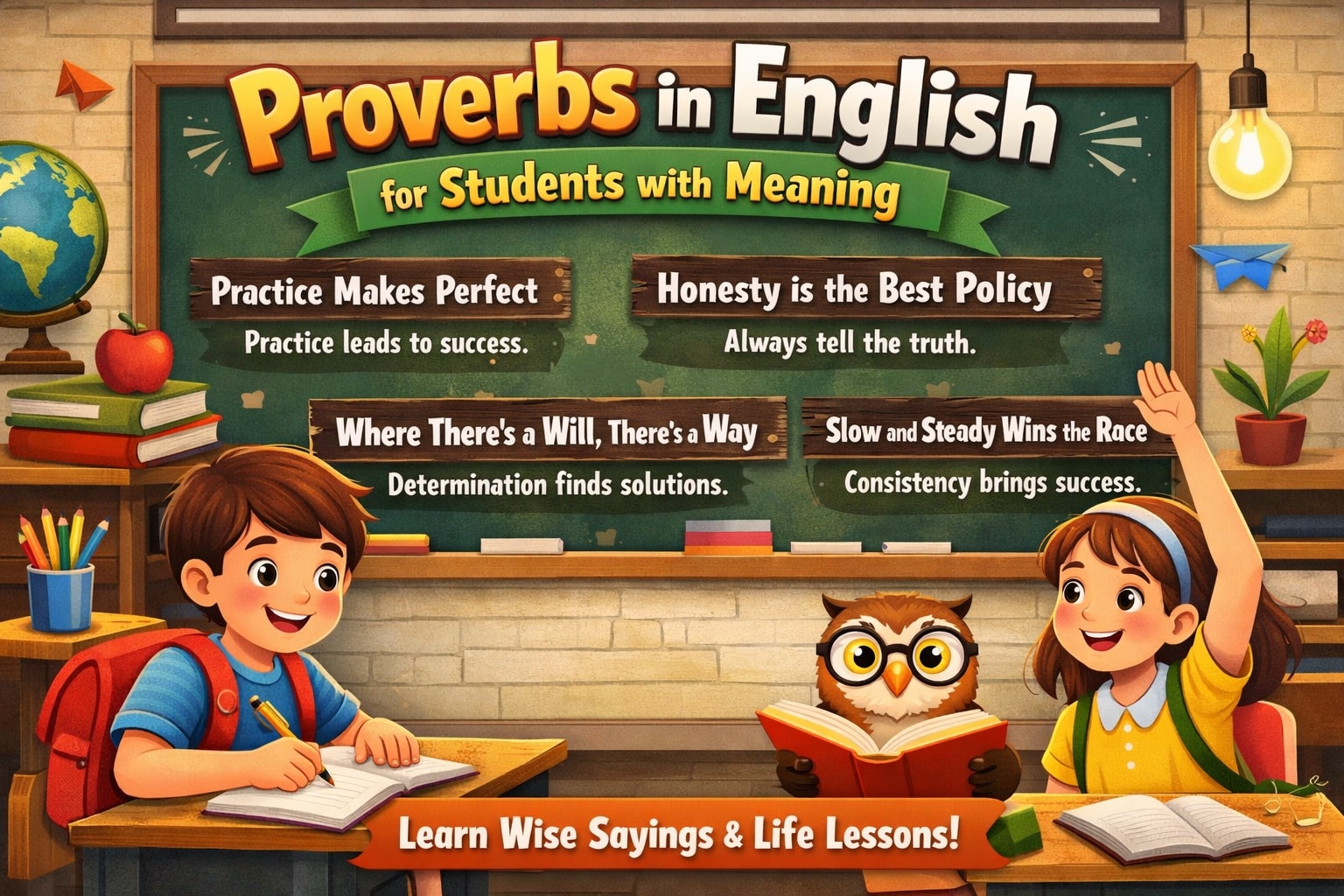
Proverbs are short, well-known sayings that express a general truth or piece of advice. For students, proverbs in English are especially helpful because they improve vocabulary, enhance writing skills, and teach important life lessons in a simple and memorable way. Learning proverbs also helps students understand moral values and use expressive language in essays, speeches, and daily conversations.
What Are Proverbs?
Proverbs are short, traditional sayings that express wisdom, truth, or advice based on common life experiences.
They usually carry wisdom, moral lessons, or practical advice. In English language learning, proverbs help students understand figurative language and think beyond literal meanings.
Importance of Proverbs for Students
Proverbs play an important role in a student’s overall learning and personality development. They help improve English fluency, make writing more impactful, and teach values such as honesty, patience, hard work, and discipline. Many school exams and competitions also include questions based on English proverbs and their meanings.
20 Proverbs in English for Students with Meaning and Examples
1. Actions speak louder than words
Meaning: What you do matters more than what you say.
Example: He always helps others quietly, proving that actions speak louder than words.
2. Practice makes perfect
Meaning: Repeated practice improves skills.
Example: She practiced mathematics daily, showing that practice makes perfect.
3. Where there is a will, there is a way
Meaning: Strong determination helps overcome difficulties.
Example: Despite financial problems, he succeeded because where there is a will, there is a way.
4. Honesty is the best policy
Meaning: Being truthful is always the right choice.
Example: She returned the lost wallet, believing honesty is the best policy.
5. A stitch in time saves nine
Meaning: Solving a problem early prevents bigger trouble.
Example: He repaired his bicycle early, proving a stitch in time saves nine.
6. Better late than never
Meaning: Doing something late is better than not doing it at all.
Example: He submitted his assignment late, but better late than never.
7. Knowledge is power
Meaning: Education gives strength and confidence.
Example: She reads daily because she believes knowledge is power.
8. All that glitters is not gold
Meaning: Appearances can be misleading.
Example: The job looked attractive, but all that glitters is not gold.
9. Time and tide wait for no one
Meaning: Time never stops for anyone.
Example: He values punctuality because time and tide wait for no one.
10. Slow and steady wins the race
Meaning: Consistent effort leads to success.
Example: She topped the class by studying daily—slow and steady wins the race.
11. Look before you leap
Meaning: Think carefully before making decisions.
Example: He checked the details before investing, remembering to look before you leap.
12. Every cloud has a silver lining
Meaning: Every difficult situation has something positive.
Example: Losing the match motivated him to practice harder—every cloud has a silver lining.
13. Rome was not built in a day
Meaning: Great things take time and patience.
Example: Learning English fluently takes time because Rome was not built in a day.
14. Health is wealth
Meaning: Good health is the greatest treasure.
Example: She exercises daily because health is wealth.
15. United we stand, divided we fall
Meaning: Unity gives strength; division leads to failure.
Example: The team won because they worked together—united we stand, divided we fall.
16. As you sow, so shall you reap
Meaning: Your actions decide your results.
Example: He studied sincerely and passed with good marks, proving as you sow, so shall you reap.
17. Don’t judge a book by its cover
Meaning: Do not judge someone by appearance.
Example: He seemed quiet but was very talented—don’t judge a book by its cover.
18. Empty vessels make more noise
Meaning: People with little knowledge often talk the most.
Example: The student who knew less kept boasting—empty vessels make more noise.
19. Necessity is the mother of invention
Meaning: New ideas come from needs or problems.
Example: Online classes became popular during lockdown—necessity is the mother of invention.
20. Hard work pays off
Meaning: Effort always brings success.
Example: Her dedication proved that hard work pays off.
How Students Can Use Proverbs in Daily Life
Students can use proverbs while writing essays, speeches, letters, and stories. They also help in improving spoken English during debates, presentations, and group discussions. Understanding proverbs makes communication more effective and impressive.
Why Learning Proverbs Is Important for Exams
Many school exams include questions like “Explain the proverb” or “Write the meaning of the proverb.” Competitive exams, Olympiads, and English language tests also use proverbs to test comprehension and vocabulary skills.
Conclusion
Learning English proverbs with meaning and examples helps students grow academically and morally. These 20 proverbs are easy to understand, commonly used in schools, and perfect for exams, essays, and spoken English. By practicing and applying proverbs in daily life, students can improve both language skills and character development.
FAQs
Proverbs are short sayings that give advice or express a general truth.
Proverbs help students improve English, understand moral values, and write better answers in exams.
They test understanding, vocabulary, and moral values and help students score better marks.
By learning the meaning with real-life examples and using them in daily conversation.
Yes, they make spoken English more natural, confident, and impressive.
Also Read: